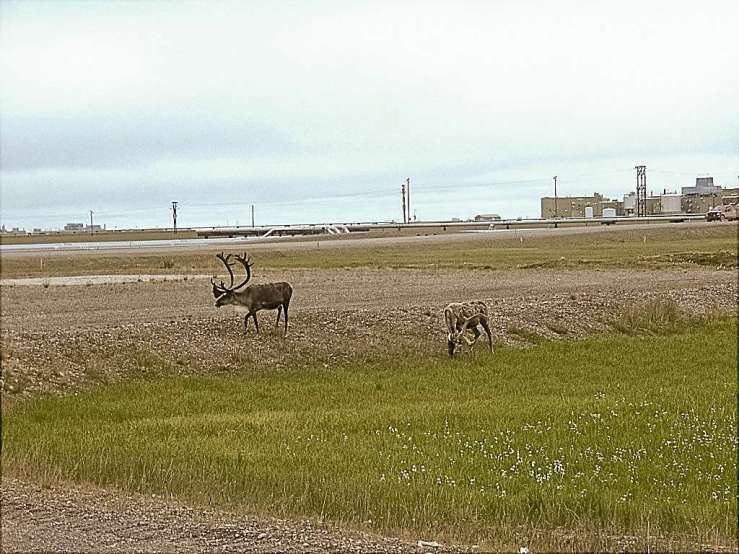
Caribou at Prudhoe Bay, Public Domain Image courtesy of PICRYL
After virtually walking the Pennine Way, following Simon Armitage’s route from north to south—a rugged but manageable hike—I was ready for something longer, some magnificent digression that would last for years and encompass all the twists and turns of my imagination. I was ready for the walk of walks. Perhaps the Pan American Highway? A 30,000 mile trek on what is considered the longest road in the world would take me from Prudhoe Bay, Alaska, to Ushuaia, Argentina. But I would have to cross (virtually, of course) the dangerous Darién Gap, where the hazards are many and the comforts are few. As I walked south, I would likely meet brave people walking in the opposite direction who might question my sanity. And, most important of all, after a short (virtual) ferry ride, I would end up on Isla Grande de Tierra del Fuego, where Ushuaia is located. In other words, I would be many miles from home and way too old to even consider walking back. And I knew where I wanted to end up. Home.
Because I had already committed to starting from Prudhoe Bay, I decided to follow the first part of my original plan, walking to Fairbanks, Delta Junction, Whitehorse, and Edmonton, all places I had never actually seen in person. That part of the journey took almost two years, and for part of the time I was trudging in the vicinity of raging Canadian wildfires. I wasn’t there in real life, but I could almost smell the smoke.
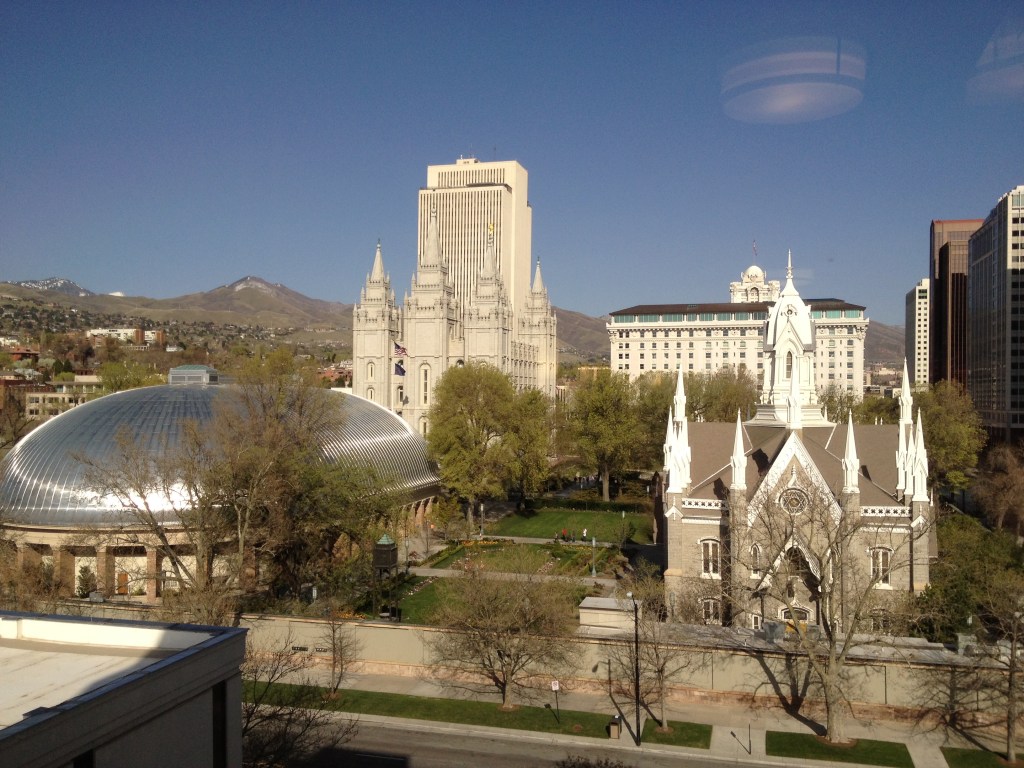
Salt Lake City, 2012
Part two of my North American adventure has taken me from Edmonton to Calgary to Missoula to—finally a place I’ve actually visited!—Salt Lake City. From there I decided to trace, in reverse, the route of a Greyhound Bus trip that I took in my younger days. My first stop after Salt Lake would be Little America, Wyoming—truck stop, gas stop, rest stop. According to AI, Little America still exists and is a major travel stop on Interstate 80. It was a warm, sunny, gas-pump-filled apparition when I whizzed through on the bus in May of 1968. But during blizzard season, as Jean Shepherd reported in 1971 in an episode of his PBS show Jean Shepherd’s America, it can be a refuge, offering food, safety, and a bed for the night. (You can watch the whole episode here: https://www.youtube.com/watch?v=mcMD14tZu10. The Little America section starts at 13:45.
My current adventure is virtual, and of course I can sleep in my own bed whether it snows or not. So, with fond memories of the (not-so-)wild Wyoming buffalo that I saw in 1968, I took a deep breath of (virtual) fresh Wyoming air and immediately set out for Cheyenne, Omaha, Iowa City, and points east.
Wyoming Buffalo, Public Domain Image courtesy of PICRYL
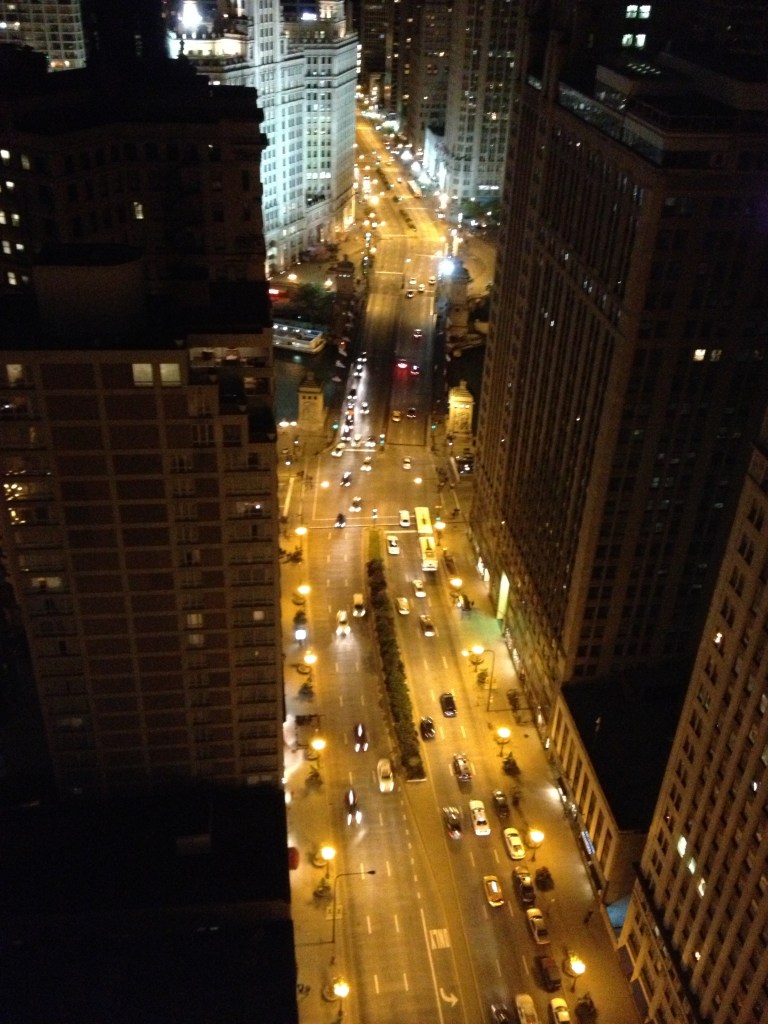
So here I am on January 6, 2026, in two places at the same time: Chicago (my virtual location) and Ithaca (my home in real life). I am listening to the “stormy, husky, brawling laughter of Youth” and the “lifted head singing” and even the “magnetic curses” that Carl Sandburg immortalized in his poem “Chicago.” I am enjoying the tall buildings and the great art and especially the “Big Shoulders,” because they make me feel safe, even though in real life my trip is still far from done. Next on my itinerary are Cleveland, Horseheads, and finally home. I have only 673 more miles to walk. I will be home by my birthday, when perhaps there will be a cake.
On the day of my brother’s birth, I woke up in my grandmother’s brass bed to the sounds of a whispered conversation in two different languages, both of which I understood, sort of. My grandmother, my vovó, had already gotten up, and I had the whole double bed to myself. When I say it was a brass bed, I use the term loosely. I know now that brass beds are not always made of brass; some are made of iron or a combination of the two metals. I also know now that brass beds are likely to be hollow, with brass plating over cast iron tubing. Vovó’s bed was hollow, and one of the finials at the foot of the bed was loose. When no one was looking, I would lift it off the bed post and position it on my head so that it looked like a crown. It was too small to be a crown for a grown-up, but I was only five years old. I would stand in front of Vovó’s mirror and pretend to be a queen or a princess. I would be happy.
On the day of my brother’s birth, I didn’t have time to play with Vovó’s finial. I had to get ready for kindergarten, but first I had to deal with the voices coming from the living room. I understood enough of the whispers to know what I was about to be told, and it was what I had been expecting. Of course I was disappointed. I really wanted a sister, but my aunts and older cousins had been experimenting with the wedding-ring trick, tying my mother’s ring to a piece of string and suspending it over her tummy, watching to see whether it swayed from side to side or moved in circles. It definitely did not move in circles. It will be a boy, they said, and everyone except me was happy.
On the day of my brother’s birth, four people were living in Vovó’s house: Vovó, my cousin Violet, my aunt Linda, and Tony, who used to be my aunt’s boyfriend and was now her husband. They had recently gotten married and were living with my grandmother until the new house they were building was ready. It would be a while. The new house was down a country road and up a narrow lane, and Tony was doing much of the work himself. People did that in those days, living with parents after the wedding, and Vovó had plenty of room now that her children were married. I was told to call Tony my uncle, but I still thought of him as my aunt’s boyfriend. The one good thing he did for me was to teach me how to catch a ball. Wait for it, he said, and, just before it gets to you, squeeze it. It worked! I would squeeze and there the ball would be, safe inside my hands. When I say they all lived in my grandmother’s house, I use the word house loosely. Vovó lived in a rented tenement, as most of us did back then. It was a big tenement on a first floor, and unlike my family’s tenement, which was a third-floor converted attic, it had both hot and cold running water, although they didn’t both come out of the same faucet. My mother had arranged to have me stay with my grandmother, her mother, while she was in the hospital waiting for the new baby. Vovó lived close to my school and would have no problem getting me there on time, but she wasn’t good at tying my hair ribbons tight enough. I was not happy about that, but I didn’t complain. I knew that I was a guest and had to be polite.
On the day of my brother’s birth, I pretended to be happy about having a brother instead of a sister. I ate my breakfast, and Vovó walked me to my school. My cousin Violet had to ride a city bus to her school. She had turned sixteen on her last birthday, and she was eager to grow up, leave school behind, and get a job. She lived with our grandmother because she had gotten very sick one day when she was a baby. Vovó, who took care of her in the daytime while her mother, my aunt Mamie, was at work, called the doctor, and the doctor said Don’t move her. So they didn’t. At least that’s the explanation I was given. I wonder now whether the Depression might also have had something to do with it. At any rate Violet lived with Vovó until she got married years later to a man named Tony—another Tony—who played clarinet in a band. He had a daytime job, but the clarinet thing was more exciting.
Aunt Mamie (Violet’s mother), Angelina (my mother), Aunt Linda, Vovó, and Violet. Photo taken on July 4, 1937
On the day of my brother’s birth, we all sat around my grandmother’s claw-footed table and had supper, and then Violet went out on a date. I wasn’t sure what a date was, but I knew it involved having a boy come for you in a car. Vovó saw a spattering of raindrops on the window and told Violet to take the guarda-chuva. Violet touched up her lipstick, grabbed the umbrella, and went out the door. After that it was all grown-up talk, and I realized that I missed my mother terribly. Vovó helped me get ready for bed.
On the day of my brother’s birth, I heard loud noises and screams coming from the living room. I had been having a crazy dream about pendulums swinging back and forth, and at first I thought the noises were part of the dream. But I recognized the voices of Vovó, Aunt Linda, Tony, and Violet, and I knew something bad had happened. I walked out of Vovó’s bedroom, and nobody paid any attention to me. Violet was still holding the umbrella, and she looked angry. Vovó was hugging her, helping her unbutton her coat. Aunt Linda was sitting on the floor, leaning against the wall, trying to wedge her feet under the linoleum, while Tony tried to pull her back up into a standing position. What happened? I asked. Nobody answered. Then Vovó told me to go back to bed. Aunt Linda was still working at getting a whole foot, with its shoe on, under the linoleum, which was of course tacked to the hardwood floor. No one would talk to me. So I went back into my grandmother’s bedroom, pulled the loose finial off the bed post, and put it on my head. I wanted to be the queen.
On the day after the day of my brother’s birth, Aunt Linda, who was her normal self again, helped me put all the pieces together in my head. Here’s what happened: Violet’s date dropped her off at the curb and then drove away. As Violet was walking toward the door, a man—a stranger—jumped out of the bushes and tried to grab her. Violet began hitting him with her umbrella, hitting him hard, all the while screaming as loud as she could. She was a loud screamer, and her screams woke any of the neighbors who might have been asleep. But it was still early and probably no one was asleep except me. Violet kept on hitting—it was a big umbrella—and lights came on, people looked out of windows, and the man ran away. Back into the bushes, back into whatever sort of world people like that live in, back away from the safe world of good people celebrating good things like the day of my brother’s birth. When you go out on a date, Aunt Linda said, and she probably even wagged a finger at me although I can’t remember for sure, make sure your date gets out of his car and walks you to your door. I still wasn’t sure what a date was. I still was only five years old. But I would hear that advice often over the years from my aunt and from my mother, whom I still missed terribly and wouldn’t see for a couple more days. Violet didn’t say a lot, though. She was tough and brave.
On the day of my brother’s birth, I learned that good and evil can be so close together that if you squeeze at the wrong time you might get something you don’t want. I learned that gold crowns don’t grow on brass beds. I learned that yes, of course, a girl’s date should walk her to her door, but what if he doesn’t? What if he doesn’t? It would be a long, long time before I went on a date of my own, but I knew what I had to do. Simple enough. Always, whether the sun was smiling like a big yellow omelet or the rain was spitting its anger against the windowpane, I would carry an umbrella. A big one with a long, curved handle. Every time I went on a date. Always.
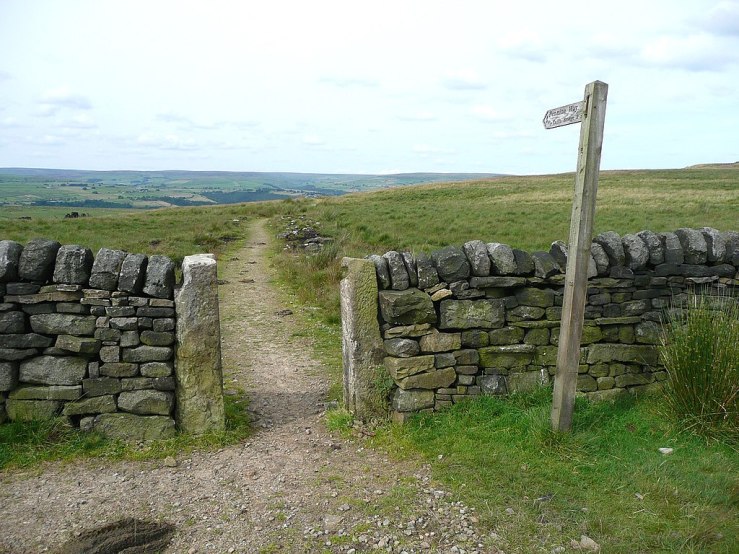
The Pennine Way by Humphrey Bolton, CC BY-SA 2.0, via Wikimedia Commons
After my stop in Xi’an, I was eager to resume my walk. But was I ready for a difficult multi-year trek to the Russian Far East and the Bering Strait? Would I arrive in winter, and would the strait be frozen solidly enough so that I could walk across the ice, possibly wondering whether Sarah Palin was watching me from her house? Did I have warm enough socks? (Even on a virtual trip it is always important to have good socks.) After serious weighing of pros and cons, I decided it was time for something completely different. Of course it was!
Here’s what I did: I transported myself to Kirk Yetholm, a Scottish village close to the English border. My plan was to walk the Pennine Way north to south in the footsteps of Simon Armitage, as described in his book Walking Home: A Poet’s Journey. I should add—not that you haven’t already guessed—that my footsteps would be completely virtual, although Armitage’s footsteps were earned, every one of them.
Most hikers walk the Pennine Way from south to north, but Armitage chose to walk in the wrong direction because, as a poet, he was “naturally contrary.” Well, yes, poets are contrary, but the real reason was that he wanted to walk toward rather than away from his home, which happened to be at the southern end of the route. Makes sense to me. He borrowed a rucksack from his mum and planned to rely on the kindness of strangers and friends to drive his heavy suitcase from each stopping point to the next, because who on a three-week walking trip wants to stop and do laundry? Besides, a poet never travels without his books, and the books were in the suitcase. The walk was well planned. Armitage posted his schedule on his website and announced his plan to give a poetry reading at each village along the way (with the exception of Once Brewed, where he would arrive on the day of the World Cup Final). To raise money for incidental expenses along the way, he planned to pass a hat; when the time came, he decided on a sock instead of a hat, as the sock provided a measure of privacy for the contributors. He did quite well with the sock, although the many £1 coins he received made his suitcase even heavier. At one point he was able to “launder” them—the coins, not his dirty clothes.
Simon Armitage is the current Poet Laureate of the UK, but I heard of him when he was elected Oxford Professor of Poetry in 2015, five years after his hike down the spine of England. Of course it was his walking that interested me. Poets tend to be walkers—think William Wordsworth, John Clare, and, closer to home, A. R. Ammons, who once wrote a famous essay about poetry and walking. The essay, titled “A Poem Is a Walk,” first appeared in print in Epoch 18 (Fall 1968) and is now all over the internet for anyone who knows how to google. Ammons—called “Archie” by those of us who knew him—said this: “How does a poem resemble a walk? First, each makes use of the whole body, involvement is total, both mind and body. . . . The pace at which a poet walks (and thinks), his natural breath-length, the line he pursues, whether forthright and straight or weaving and meditative, his whole ‘air,’ whether of aimlessness or purpose—all these things and many more figure into the ‘physiology’ of the poem he writes.” Archie had much more to say about poetry and walking, and his essay is well worth reading.
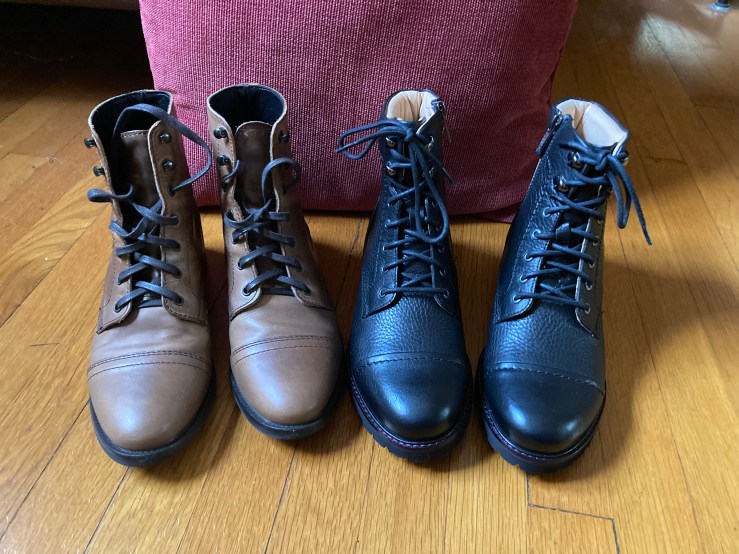
Of course Archie is right, and I am oversimplifying a complex argument when I say that poems are made of motion, footprint by footprint. Iambs are footprints, heel toe, heel toe, and if you trip on a pebble or get momentarily stuck in a mucky peat bog, you might get something resembling an anapest or a dactyl. Even if you don’t count your footsteps, they are there, heel-toeing across the page, returning home. Writing poetry is hard. You need warm socks and sturdy boots if you are to go the distance.
I am reading Simon Armitage’s book as I make my virtual footprints along the Pennine Way. I am almost keeping up with him, headed toward Hawes village, which promises furniture stores and pastry shops. I will enjoy the pastry shops, I think. So let’s go walk some poems. I already have the boots.
Yes, I did it! I walked most of the way across China, starting at Kashgar, a city near China’s western border. Although I walked the miles actually (really, truly), I accomplished the trip virtually (not really, not truly), tracking my progress on a spreadsheet and a map, putting one foot in front of the other wherever my feet happened to be, which was not China. I have never been to China. I would like to go there someday, but in the meantime walking is good exercise, and for me the exercise is more meaningful—i.e., less boring—if I feel I’m getting somewhere.
My walk from Kashgar to Xi’an was the third leg of my great Silk Road adventure. Part one, which I started on August 1, 2018, took me from Istanbul to Tehran, a distance of 1994 miles. I completed that journey on November 24, 2019, and immediately started part two, a 1948-mile trek from Tehran to Kashgar. Heading still farther east, I left Kashgar on March 12, 2021, and arrived at my destination last Sunday, September 25, 2022, having walked (virtually) 2582 miles of deserts and orchards and glacial waterways. That’s 6524 miles in five years, one month, and twenty-five days. I didn’t rush.
Bernard Ollivier, a retired French journalist, did me one better by walking approximately the same route as mine back at the turn of this century—an in-person walk—and then writing about his experiences in a three-volume set of books: Out of Istanbul, Walking to Samarkand, and Winds of the Steppe. I was more than halfway through my own journey when I learned about his books; I haven’t read the first two, and I’ve only dipped into the last one.
Kashgar, which was a major stop along the Silk Road, is famous for its Sunday market and for its varied citizenry. According to Ollivier, “every single Central Asian ethnic group is represented. Local Uyghurs wear Western dress. but the others—Kyrgyz, Kazakhs, Mongols, Tjiks, Uzbeks, and Afghans—are often in traditional garb.”
After Kashgar, I hiked through the deserts and mountains of the Xianjiang region, stopping in Aksu and Korla to eat (in my imagination) the delicious apples and pears that those cities are famous for. You can read about that part of my trip here:
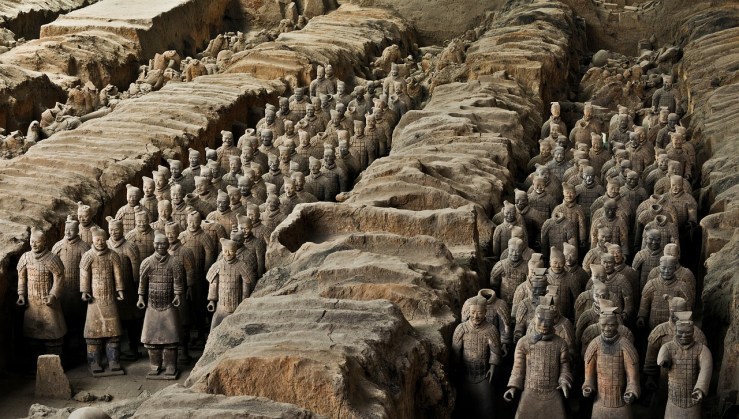
And finally, as they say in the GPS world, I have reached my destination: Xi’an, capital city of Shaanxi Province and the oldest surviving capital of ancient China. More specifically, I have arrived at Terracotta Warriors and Horses Museum. Although the buried army of clay soldiers was constructed from 246 to 206 BC, it was uncovered relatively recently. The soldiers, each with individual facial features, were designed to guard First Emperor Qin in his afterlife. More than 700,000 workers were required to construct them. The artisans used molds for heads, limbs, and torsos, assembled the parts, and then applied more clay to the surfaces of the heads so that artists could add individual features to faces and hairdos. In 1987 UNESCO designated the tomb as a World Cultural Heritage Site. I would love to visit that museum in person, but I am grateful to all the wonderful photographers who have made their images available on the internet.
Having reached my goal, what should I do next? I could check out the famous Bell Tower and the city’s crenellated fortifications. Or I could spend a couple of days sampling the fare at Xi’an’s best restaurants—after doing laundry, of course, and washing my hair. But no, the world is big and full of wonders. I have other places to go and other things to do. In fact, I have already mapped out my next journey, which I’m excited about, and I’ve started walking. More about that next time. However, before I left Xi’an I couldn’t resist paying a quick visit to First Noodle Under the Sun—this delightfully named restaurant does exist in Xi’an, and it gets good reviews!—for a nourishing (imaginary) meal to sustain me as I set off for new adventures.
Image by Terence Cuneo, Public domain, via Wikimedia Commons
“Once in a lifetime,” Miss Smith told us. “Or maybe twice.” She was our fifth-grade teacher, and she wanted to make sure we paid attention to the coronation of Queen Elizabeth II of England, which would be happening in about a month. We knew that Princess Elizabeth was now the queen of England, but the coronation would make it official, just as an inauguration made the position of the president of the United States official. In January most of us had watched on television as President Eisenhower took the oath of office. (It was a school day, and I don’t remember whether we watched the live broadcast or saw replays on the news. We would have gotten home from school early enough to catch the parade, with the marching bands and floats.) What I remember most about Eisenhower’s inauguration was that he chose to wear a homberg instead of the traditional top hat. Inaugurations happen every four years in the United States, but in England a coronation requires a much longer commitment. The queen would be expected to do her job forever, or until the day she died, whichever came first. Queen Elizabeth was still a young woman. We decided that Miss Smith was probably right about this being a once-in-a-lifetime event.
Miss Smith presented us with a project and a challenge. We were, each of us, to prepare a coronation scrapbook, which would contain information about the coronation, clippings from magazines or newspapers, anything we could find of relevance. She told us to keep our eyes and ears open, to check the evening newspaper every day, and of course to ask our mothers’ permission before cutting up their magazines. She would provide the blank scrapbooks (which she bought with her own money) and our job was to fill them, making them as complete and attractive as possible. There would be prizes for the three best scrapbooks.
The Couto family didn’t have a lot of magazines at home. My mother subscribed to McCall’s, and of course we got Parade every Sunday in The Standard-Times. Neighbors who knew about the project sometimes would give me magazines after they finished with them. I got busy with my scissors. I don’t remember whether I used LePage’s Mucilage or plain white paste to attach my clipped articles, but I do remember trying to arrange everything in something like chronological order.
My mother called my attention to an article that I probably would have missed because I didn’t recognize the man and the woman in the photo. If I remember correctly, the caption read “Duke, Wally to Watch Coronation on TV,” although I am probably remembering incorrectly; I doubt that Wallis Simpson was ever called “Wally,” but what do I know? “Duke” and “Wally” were both boys’ names, as far as I was concerned, and I didn’t know who was which. (Actually “Duke” sounded more like a dog’s name; one of my aunts had a neighbor with a dog named “Duke.”) “Is this about the coronation?” I asked my mother. She said it was, and I got out my scissors.
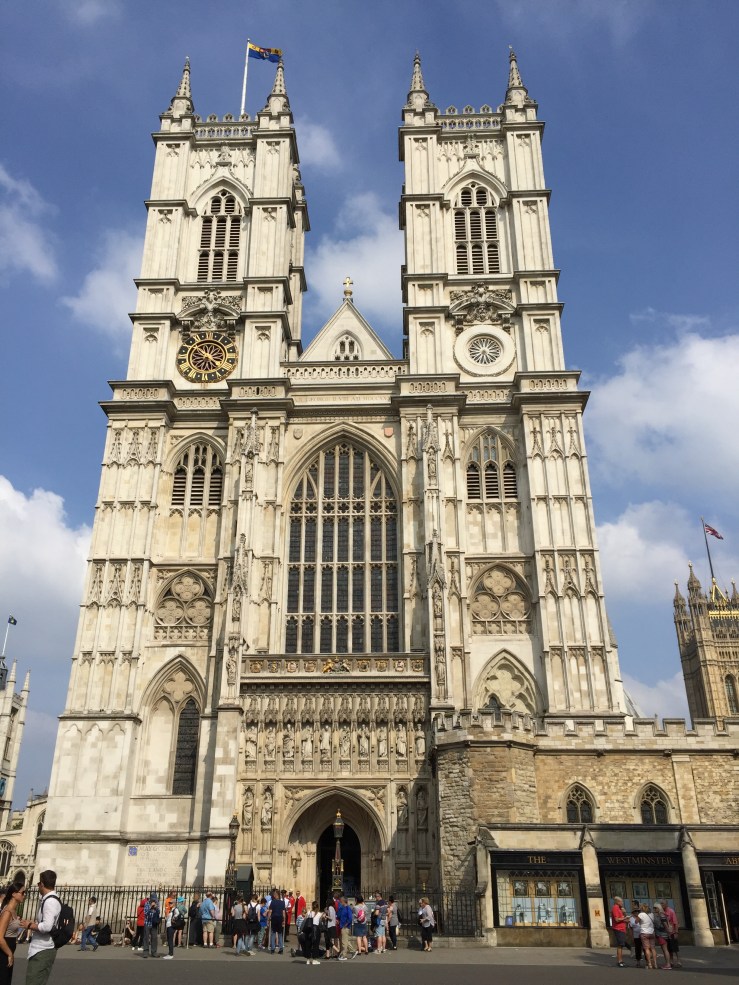
The coronation took place in Westminster Abbey, and I remember watching it. I think Miss Smith arranged for us to be able to take part of the day, or maybe even the whole day, off from school so that we could watch this first televised English coronation. The event was so important that TV Guide put Queen Elizabeth’s picture on the cover of that week’s issue, even though she wasn’t a TV star. The major networks carried the ceremony live (and very early, due to the time difference) using the new trans-oceanic technology, and they also arranged to have BBC kinescopes flown in RAF jets to North America for a less-fuzzy evening recap.
The Room Where It Happened
I remember the fuzziness of the live transmission. Queen Elizabeth looked tiny on our black-and-white TV screen, and she looked even tinier when the heavy crown was placed on her head. Shakespeare was being metaphorical when he wrote “Uneasy lies the head that wears a crown,” but that crown, with all those crown jewels, had to have been uncomfortable. Later the royal family appeared on the balcony of Buckingham Palace: Queen Elizabeth, the Duke of Edinburgh (who would later become Prince Philip), Prince Charles, Princess Anne, and the Queen Mum, along with other royals that I didn’t recognize. I remember thinking it was a good thing the queen already had two children because now she would be too busy to have any more. I was wrong about that. What really impressed me about that balcony scene was the way the royal family waved—not flapping their hands, as in waving bye-bye, but raising their arms like scepters and moving their hands in a circular motion.
Miss Smith was one of my favorite teachers of all time. She brought books to school (that she bought with her own money) and set them up in the back of the classroom; if we finished our work early we could pick a book to read and even borrow it to take home if the story was really interesting. Thanks to Miss Smith I read all the Little House on the Prairie books, The Secret Garden, and much more. I was never bored that year. As for the coronation scrapbooks, I won second prize. My prize was a silver mechanical pencil, which I still have somewhere in my brother’s attic in a box with my coronation scrapbook and other memorabilia. I haven’t seen the scrapbook in decades, but I have never forgotten my coronation experience.
Wanting to read the final chapter, I woke up very early yesterday morning to watch the queen’s funeral on a much larger TV than the one I saw the coronation on. Westminster Abbey is a grey and gold splendor with a black-and-white checkerboard floor that somehow imposes a sense of order. The overhead shots were almost like looking through a kaleidoscope. I thought, if I shake this all the colors will swirl and be beautiful. But I do not plan to make a funeral scrapbook. The LePage company no longer makes Mucilage, and, though I would miss the squeaky sound of the rubber tip, the glue would be useless in an age when all the articles are online. But if I did make another scrapbook, it would be a good one. I can always use another pencil.
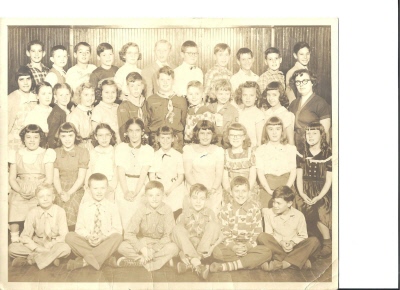
The Coronation Scrapbook Kids. Miss Smith is on the right, 3rd row, the adult in the room. I am in the 2nd row, the one with the turned-up pigtails.
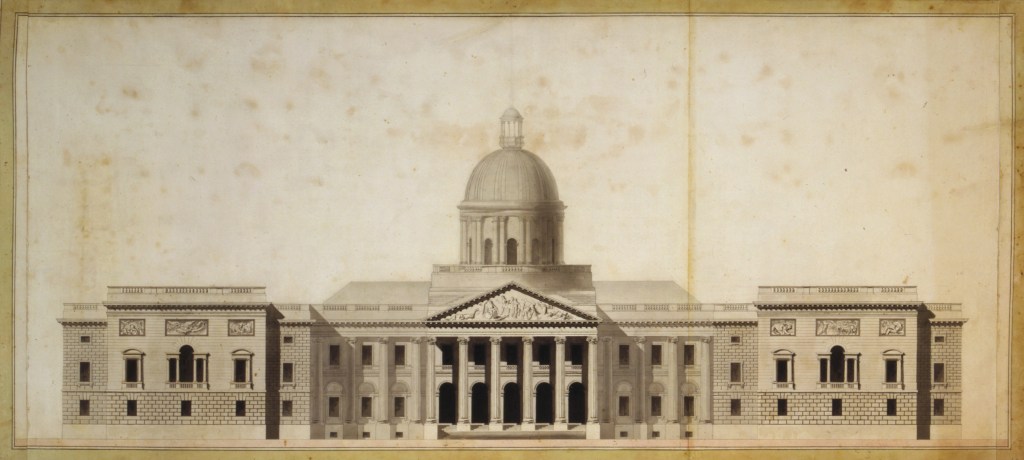
United States Capitol, East Front—public domain image courtesy of Library of Congress
It was a kinder, gentler time, or at least I thought it was. I was unemployed and unhappy, and I wanted—no, needed—to go somewhere. My friend Joyce, who was about to move to Washington to seek her fortune, offered me a ride. Although Washington was not on my list of places to go for a fresh start, it was definitely somewhere. I started packing.
Joyce had already made arrangements to move in with a college roommate, so I got a room in McLean Gardens, a conglomeration of red-brick apartment houses and rooming houses with a Marriott Hot Shoppe on the grounds for those of us without cooking facilities. McLean Gardens was conveniently located on Wisconsin Avenue, just a bus ride away from downtown Washington, the White House, the National Gallery of Art, and the Capitol.
Before either of us started job hunting, Joyce and I spent a couple of days seeing the sights. We visited the Washington Monument, the Lincoln Memorial, and JFK’s grave at Arlington Cemetery. And then we went to the Capitol; we walked up the front steps and through the front door, looked around briefly, and used the ladies’ room. On the third day, I decided to try my luck at the temporary typing agencies.
Joyce was looking for her dream job. I wasn’t so ambitious, but I could type 65 words a minute on a manual typewriter. At the first temporary agency I went to, they let me take the test on a manual and then offered me a two-week job at an insurance company. I would, however, have to use an electric typewriter, which I had never even seen up close and personal. “Bluff it, honey,” said the woman at the agency.
Imagine my surprise when Joyce showed up at my room a few days later to tell me she was giving up on Washington. Jobs were scarce, or at least the good ones were, and she was driving back to Massachusetts to reassemble her career plans. Once again she offered me a ride, but this time I said no, thank you. The people at the insurance company were friendly, a nice co-worker had already pointed out the switch that started the electric typewriter, and I wanted to see how this latest phase of my life was going to play out. Joyce left, and I was on my own.
When the insurance job ended, I got lucky. I was one of several recent college graduates hired by the National Academy of Sciences to administer fellowship applications for the National Science Foundation. We were not scientists. Mostly we just opened envelopes and filed the contents in dossiers. But it was a congenial office, and I liked working there. This temporary job lasted all fall and winter, culminating with the arrival of the panels of senior scientists who would select the fellowship recipients.
Each weekend, after laundry and shopping, I took advantage of that Wisconsin Avenue bus—I think it might have been the 30-something—to visit one of Washington’s magnificent museums. A whole year of Sundays wouldn’t have been long enough to fully appreciate the treasures in the National Gallery of Art, and my last stop each visit was the room with Monet’s Rouen Cathedral paintings. I went to other museums as well, including the Folger Shakespeare Library, which shared a bus stop with the Capitol. That’s when I got into trouble.
United States Capitol, West Front—public domain image courtesy of Wikimedia Commons
You see, it had been a long bus ride, possibly longer than usual because of traffic or crowds, and I had to go to the ladies’ room. For some crazy reason, I thought the Folger Library, being a smaller museum, might not have a ladies’ room. Since I knew the restrooms at the Capitol were right near the front entrance, I thought: Why not pop into the Capitol, do what I have to do, and then head over to the Folger Library?
Here’s what I didn’t know: The Capitol has two fronts, the East Front and the West Front. I don’t know which front Joyce and I had entered through on that first week in Washington, but this time I was certainly at the other one. There was no ladies’ room at the entrance or even around the corner. I kept thinking I was remembering wrong and if I just took another turn, went a few steps farther, then there it would be in all its porcelain glory. No luck. After a few wrong turns, I was lost. I couldn’t even find my way back to the door. When I saw a line of people who seemed to know where they were heading, I joined them. Soon we were entering a large chamber, possibly the House of Representatives, and someone was taking tickets. I didn’t have one, so I quickly said excuse me and backed out into the hall. I wished I had brought a compass or at least a map.
After a few more anxious minutes, I found myself in a corridor that seemed to contain offices. There were names on the doors, but I didn’t recognize any of them. And then a distinguished-looking older man came out of one of the doors and asked me where I was going and whether he could help me. I didn’t want to tell him I was looking for the ladies’ room, so I said I was lost and couldn’t find my way out. He summoned a young man, probably a page and asked him to show me the way. The young man must have had nothing better to do that afternoon, because he gave me a leisurely tour of the parts of the Capitol that we walked through. I wish I could remember every detail, but what stands out most prominently in my memory is Statuary Hall with its gleaming marble and its sculptures. It was beautiful!
My temporary job ended, and I left Washington in March of 1968. Earlier I suggested that my Washington adventures happened in a kinder, gentler time, but I was wrong. On April 4 of that year, Martin Luther King, Jr., was assassinated. Washington responded with four days of rioting. In retrospect I think no one should have been surprised. Tensions had been building for a long time.
Many years later, in another world—maybe kinder and gentler, but maybe not—I spent a few days in Washington with my husband. He was attending a conference, and I was mostly on my own during the daytime. I decided to visit the Capitol. This time it was not possible to walk through the front door, either East Front or West Front, and just start exploring. I had to let someone search my tote bag, and there probably was a metal detector as well. I took one of the tours and remember seeing the Crypt and the Old Senate Gallery. The best part of the tour was Statuary Hall, because this time everything was familiar and my long-ago tour guide’s words were still resonating in my memory.
Happy Fourth of July! And in case anyone is wondering, the Folger Shakespeare Library does have restrooms.
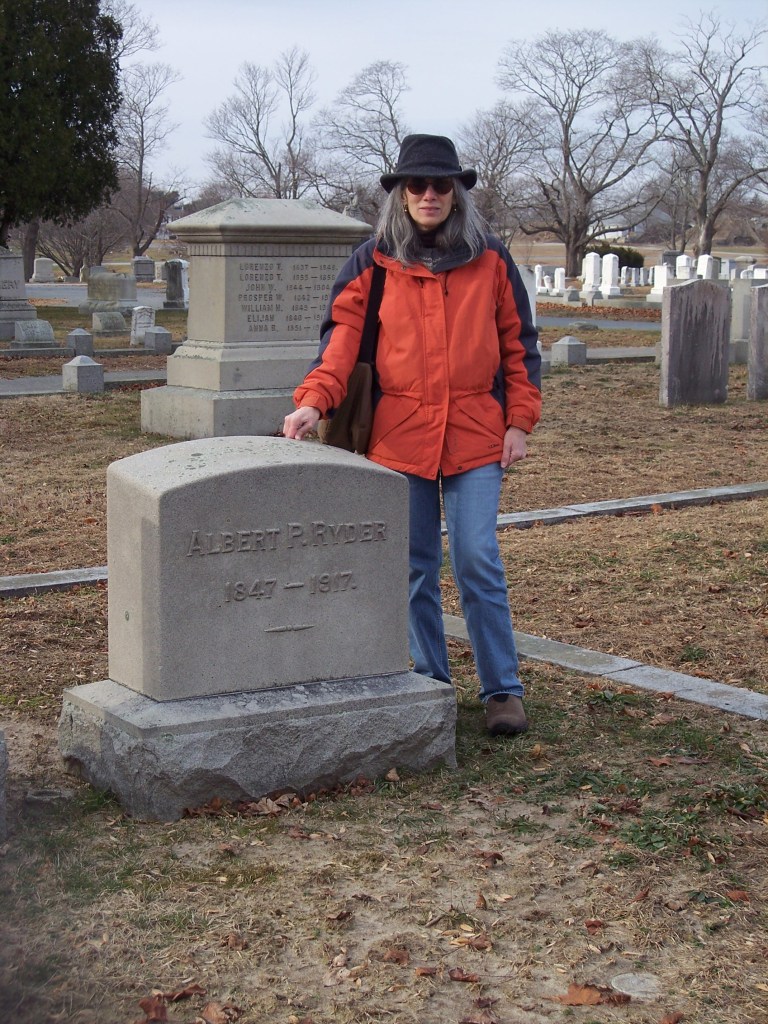
Albert Pinkham Ryder and Me, Rural Cemetery, New Bedford
Because I am a poet, I respond to words before images, sentences before styles, paragraphs before pigments. I love to look at paintings, but for me words come first. It is not surprising, then, that my obsession with Albert Pinkham Ryder, a painter who was born, as I was, in New Bedford, Massachusetts, began not with a museum exhibit but with a review of one. When I read John Updike’s “Better Than Nature” in the November 8, 1990, issue of The New York Review, I was particularly impressed with Updike’s descriptions of Ryder’s technique and of the resulting fragility of his art. The exhibition being reviewed was at the Brooklyn Museum and ran from September 21, 1990, to January 7, 1991. It was an event. Updike wrote, “This show will not come round again, if only because Ryder’s paintings are so fragile and festering that they are disintegrating before, as it were, our collective eyes.”
I wanted to see that exhibit but never made it to the Brooklyn Museum. Upstate New York, where I live, is not close to Brooklyn, and life and my job got in the way. Since 1991 I’ve seen Ryder paintings in various museums, but only one or two at a time, never a whole room full of them. This year, despite Updike’s warning, I will get a second chance. I am determined to see “A Wild Note of Longing” at the New Bedford Whaling Museum before the exhibition closes in October.
Even before experiencing any of his art, I wanted to know more about Albert Pinkham Ryder’s life and work. I went to a library, looked through some books, and was very surprised to learn that Ryder is buried in Rural Cemetery, where my parents are buried. We have a family plot, which means that Ryder is a future neighbor. On my next visit to New Bedford and maybe the one after that, I tried and failed to find his grave. Finally I went to the cemetery office and asked where it was, expecting to be given a lot number or other form of cemetery address. Rural Cemetery is very old, and the oldest sections are full of turns, easy to get lost in. The people in the office didn’t give any indication that they recognized Ryder’s name. They may have thought I was looking for my great-grandfather. But they went beyond the call of duty and sent a man in a pickup truck to escort me and my husband to the grave, which is in a very peaceful section of a very peaceful place. We will be neighbors, but not close neighbors. I sent a photo of the gravestone to Find a Grave, where I am known as “Zenobia.”
One sentence in John Updike’s review jumped out at me as soon as I read it. “Ryder,” Updike wrote, “in his reckless, betranced quest for poetically lustrous surfaces committed every chemical sin in the book, mixing his oils with alcohol, bitumen, and candlewax, painting ‘wet-on-wet,’ applying rapid-drying paints (flake white, umbers, and Prussian blue) on top of ‘slow driers’ like lamp black and Van Dyke brown, pouring on varnish straight from the bottle and painting on top of the still-tacky surface.” Because I am a poet and not a painter, I wrote a poem using part of the above sentence as an epigraph. The poem isn’t about Ryder, but then it sort of is because he inspired it. The poem was first published in Black Warrior Review and is included in my chapbook, Carlisle & The Common Accident. Here it is:
CHEMICAL SINS

. . .Ryder in his reckless, betranced quest for poetically lustrous surfaces committed every chemical sin in the book. . .
                    —John Updike on Albert Pinkham Ryder


So, Carlisle reflects, art shadows life
in both tenacity and dissolution,
and mixes another drink and thinks about

art and luminosity and Faustian
negotiations.  Life, she reflects,
sucking a pimiento from an olive,

is luminous enough, all those tiny
pricks of light scattered along a space-
time continuum.  Rattling the cubes,

she thinks about life, how it accrues
dimension as it jerks along, caught
in ratchets, and she measures out another

shot of gin and tears into a bag
of Ruffles and nibbles and reflects
on chemistry, what little she remembers

from high school, a clutch of rotten-egg
experiments, some graduated beakers
of hydrochloric or sulfuric acid,

lots of dirty Pyrex to wash
afterwards.  She thinks about the stack
of dishes in her sink when all those lights

crackle, then suddenly start to wink at
random, eccentrically spaced
markers in some postimpressionist

universe, all absurdly almost
within reach.  A couple more drinks,
she’ll touch them, fingertips a trail

of auras that ionize and glow
in the dark.  But the chips are down
to a few greasy crumbs and she knows

a French roast and a Tylenol will work
their chemistry on the tenacious headache
she’ll wake with in the morning.
The Vieira Family: My grandfather Joseph Vieira surrounded by my grandmother Margarida Frias Vieira, Mamie Vieira (older girl), Angelina Vieira (younger girl), and Walter Vieira.
Yesterday was the Fourth of July. Independence Day is not my favorite holiday. In fact, it’s my least favorite holiday, not because I lack patriotic fervor and not because I hate fireworks (although I do hate fireworks if they’re directly over my head)—no, not for either of those reasons. I certainly don’t hate the music, most of which was written by John Philip Sousa, and I even like the Bizarro version of “Stars and Stripes Forever” with its lyrics about ducks and mothers. In fact I love the music, and I used to love the annual telecast of the Boston Pops concert from the Hatch Shell. The evening always ended with Tchaikovsky’s 1812 Overture and televised fireworks over the Charles River. This year’s concert was performed at Tanglewood, although the fireworks still happened in Boston. Unfortunately our PBS station didn’t carry any of it, opting instead for A Capitol Fourth, which I didn’t watch and don’t have anything bad to say about except that it’s not the same thing. I like things to be the same. I like tradition. My problem with this particular holiday is that traditionally (for my family, at least) it has been a terrible, horrible, no good, very bad day.
First there was my maternal grandfather, Joseph Cabral Vieira, who arrived in New Bedford on June 2, 1903, on the S.S. Peninsular. He was 20 years old and traveling with his sister Virginia to join his mother, Amalia, and his brother and other sisters. He loved his new home. He soon met my grandmother at a dance, married her, and made a life for himself and his family in bustling New Bedford. His dream was to become an American citizen. First he had to learn to write his name, and he practiced, over and over, writing “Joseph Vieira” on pieces of paper. Years later, after I was born and learned to read, I found those scraps of paper inside a desk he had salvaged for my cousin Violet. His handwriting was shaky, and sometimes he put the “e” before the “s” so that it came out “Joesph Vieira.” But with time he improved, and he looked forward to the day when he would take the oath of citizenship.
Unfortunately, my grandfather was not destined to become a Yankee Doodle Dandy. On the day of the Oath of Allegiance ceremony, he arrived early, excited and nervous, feeling almost like a real, live, adopted nephew of his Uncle Sam. And then the unthinkable happened. Before he could take the oath he suffered a stroke, a small stroke but serious enough to prevent him from becoming what he wanted to be—a citizen of the United States of America.
Much later, on the morning of July 4, 1941, after a few months of walking with a cane, after his lifelong dream had been squeezed out of him, my grandfather went into the bathroom to shave and get ready for the day’s celebrations. As he stood at the sink in the bathroom of his first-floor tenement on Matthew Street, the unthinkable reoccurred, this time with force and cruelty. The second stroke killed him instantly.
Because he died before I was born, I knew my grandfather only through stories that were told and artifacts that provided tangible proof of his existence. There was the radio in my grandmother’s dining room, a piece of furniture taller than I was with mysterious dials that I wasn’t allowed to touch. At Christmas there was a celluloid Santa Claus in a sleigh pulled by celluloid reindeer; if my grandmother or one of my aunts wound it up, it would move across the floor on tiny, hidden wheels. I wasn’t allowed to wind it up. There were stories about THAT DAY like, for example, how my grandmother sent my cousin Violet to Ti’ Frank’s house to fetch him; how Violet, not wanting to waste time getting dressed, raced down the sidewalks of New Bedford in her slip.
Years later, after my parents bought their first TV set, a Capehart that was way smaller than my grandfather’s radio, my mother and I watched the movie Yankee Doodle Dandy. It probably was shown as a Fourth of July special. After watching it I started mentally connecting my grandfather to George M. Cohan, who looked like James Cagney and said he was born on the Fourth of July. Because he died on the Fourth of July, my grandfather could have been the Bizarro version of the song-and-dance man on a stage where everything was red, white, and blue. Actually, as I recently learned, the only proof of George M. Cohan’s birth date is a baptismal certificate saying he was born on July 3, 1878, but the July 4 date certainly makes the better story.
One U.S. president was born on Independence Day: Calvin Coolidge came into the world on July 4, 1872, in Plymouth Notch, Vermont. Would that make my grandfather the Bizarro version of President Coolidge? Or should he remain in the company of the three presidents who died on the Fourth of July? John Adams and Thomas Jefferson both died on July 4, 1826, the 50th anniversary of the Declaration of Independence. And James Monroe followed on July 4, 1831. Let’s wave the grand old flag for all of them.
Vovô and Vovó
There were other incidents, not so terrible but not so nice, either. One Fourth of July my grandmother was sitting on her front porch minding her own business when a passing stranger tossed a firecracker into the air and it veered in her direction. She wasn’t seriously hurt, but the firecracker’s collision left her with a small black spot in the middle of the back of her hand. And in another fireworks-related accident, although this time not on the Fourth, my friend Evelyn, who was a majorette with the Dartmouth High School marching band, happened to be in the wrong place when a doofus in the stands threw a cherry bomb into the football field. Evelyn was OK, but the incident was serious enough to be reported in The Standard-Times.
The Dartmouth High School Majorettes. Evelyn is on the right, standing.
There are many ways to get from Kashgar, China’s westernmost city, to Aksu, about 300 miles to the east. If you left on train #7558, you would arrive in Aksu 9 hours and 28 minutes later. On this slowest and cheapest of the railroad options, a ticket costs only ¥53, or about US$8. That’s for a “Hard Seat” ticket. The Hard Seats are, I understand, hard, and you might arrive stiff in the joints and more skilled at using squat toilets than you were at the start of the journey. Or you could travel more comfortably with a “Hard Sleeper” or a “Soft Sleeper” ticket. Soft Sleeper carriages have both squat toilets and Western toilets, and that alone, I think, would justify paying the extra $16. Even if you didn’t actually sleep during the journey, you would have a comfortable place to sit and prepare yourself mentally for the transition from a busy Silk Road market oasis to an agricultural area famous for its apples.
Yes, apples. If you were in a hurry to sample apples so sweet that their sugar content is visible in the shape of translucent sugar stars hugging their cores, you would want to get to the Aksu Prefecture as soon as possible. In that case you could travel on the T9518, an express train with limited stops that will get you to Aksu in 4 hours and 44 minutes. A “Soft Sleeper” ticket will set you back ¥231, which is only about US$36, a real bargain! Of course the T9518’s speed will cut down on your transition time, but, oh, you’re looking forward to those apples!
There are other trains on this route, too, and these aren’t even the high-speed bullet trains that we’ve been hearing about. As far as I can tell, the bullet trains don’t run between Kashgar and Aksu, but they sound wonderful. The newest trains have sleeper compartments with bunks arranged so that sleeping people are facing in the direction the train is moving towards. Nobody has to sleep backwards. And it is possible to fly from Kashgar (KHG) to Aksu City (AKU), although China Southern has only one flight per day and their fares are considerably more expensive than the train fares. Flying takes only 1 hour and 10 minutes—not long enough, in my opinion, for transition time. I don’t like getting where I’m going before I’ve stopped missing the place I’ve left. I don’t like flying. If I were in China in real life, I would choose the train.
But in real life I’m not in China. My trip is virtual. I’m on the third leg of a virtual Silk Road walking tour that began in Istanbul on August 1, 2018. As you can see, I’m traveling slow. Very slow. I left Kashgar on March 12 of this year and didn’t arrive in Aksu until May 16. It took me just over two months to go a distance I could have done in under five hours on a Chinese train. But I’m getting there. I record my distance on a spreadsheet—actual miles that I walk wherever I am, and during the pandemic it has been mostly indoor walking, which is walking nonetheless. For this latest part of the journey, I have also been recording my progress on a website called My Virtual Mission, where many other virtual travelers are tracking many other virtual journeys and none of us is crazy. If you want to follow my progress toward Xi’an, my final destination, you can do so here:
About those apples, I Googled to see if I could buy them, either here in Ithaca or online. No, the local supermarkets don’t have them, but I did get my hopes up when I found the website of a family-owned business that sells Aksu Sweetheart Apples. Unfortunately their delivery area is restricted to New York City, parts of New Jersey, and Long Island. If I lived in one of those locations, some Aksu apples would be on their way to me as I write this. For now they will have to remain on my list of delights to be enjoyed in the future. Not now, because I’m walking again. Walking slow. I’m on my way to my next stopping point, Korla, where they grow pears.
A couple of weeks ago, as I was scrolling through the news items on Poetry Daily’s website, I came upon Ruth Weiss’s obituary. Although I didn’t know who Ruth Weiss was, the thumbnail in the news feed immediately caught my attention. Ruth Weiss, who was, according to the San Francisco Chronicle, a “trailblazing poet in the ‘boys’ club’ Beat scene,” had died on July 31 at the age of 92. She was less well known than her male counterparts and even less well known than Diane di Prima, who came later to the North Beach poetry circuit. Ruth Weiss is credited as being the first poet to read to the accompaniment of a jazz combo. And she had green hair.
The jazz poetry thing happened by accident. She was sitting in her basement apartment working on a poem when a friend rushed in, saw the poem, pulled it out of the typewriter, and ran out of the room. Ruth ran after her poem, as anyone would, and ended up in an apartment where a party was going on. There was music. Ruth was urged to read her work. She started to read, and the bassist and piano player soon joined in. She had started something.
Ruth Weiss was born to a Jewish family in Germany during a time when Nazism was gaining strength. The Weiss family got out of Berlin, seeking safety in Vienna and later in the Netherlands. They came to the United States in 1939, and Ruth’s parents became American citizens.
In the 1960s, Ruth began spelling her name in lowercase letters: ruth weiss. She was protesting against Germany, against the Nazis, against the German practice of capitalizing nouns. And, in another act of protest, this time inspired by the film The Boy With Green Hair, she dyed her hair green.
The Boy With Green Hair (1948) was directed by Joseph Losey and starred Dean Stockwell as the boy, Peter Frye. The film has been variously described as a fantasy/drama, a drama/comedy, and a parable. Because a certain amount of suspension of disbelief is required, I’ll go along with parable and fantasy. But this is not a funny movie. It’s serious stuff. Back when it was shown regularly on a classic movie network, I watched it several times. Those of us who love The Boy With Green Hair will never forget it.
Here’s the plot: The boy, Peter, has been sent to live with Gramps, a retired or failed actor now working as a singing waiter. Gramps is not his real grandfather, but the two of them hit it off. Peter believes his parents are in England working for a war relief agency but later learns that they have both been killed. Shortly after receiving this news, he looks in the mirror after his morning bath and sees that his hair has turned green. The color won’t wash out. Gramps tells him that it’s “a grand color,” but Peter wants to be like everybody else.
In what has been described as a dream scene—but I believe it really happened—Peter is wandering through the woods and meets a group of children he recognizes from the posters of war orphans that are taped to a wall in his school. “Your green hair is very beautiful,” the children tell him. “Green is the color of spring. It means hope.” They tell Peter that his hair is a symbol to remind others that “war is very bad for children.” That’s one of the messages—yes, this is a message movie—but the stronger message is about tolerance. “How many of you have black hair?” the teacher asks. She goes on to ask about brown hair, blonde hair, green hair, and red hair. “Are there any questions?” she asks.
In 2019 the director and cinematographer Melody C. Miller released a documentary film about ruth weiss. Titled ruth weiss; the beat goddess, the film has been shown at festivals worldwide and is winning awards. I don’t know when or if it will be coming to a theatre near me—or to a TV set near me—but I know I want to see it. Here’s the trailer:
ruth weiss’s hair color is sometimes described as teal, and in fact Peter Frye’s green hair was leaning toward the teal side of green. Perhaps that had something to do with the hair dyes that were available in 1948. Now, of course, it is possible to buy green hair in a drugstore. Googling, I found a range of vibrant green hues, some of which glow under black light.
The green-haired star of the moment, of course, is Billie Eilish. I first became aware of her when she sang the Beatles’ song “Yesterday” during the “In Memoriam” segment of the 2020 Academy Awards. Only 18 years old, she suddenly is everywhere. She even made an appearance at the Democratic National Convention, urging everyone to “vote like our lives, and the world, depend on it.” After her brief talk she introduced a new single, “My Future,” which she co-wrote with her brother, Finneas O’Connell. Billie Eilish’s green hair is much lighter and brighter than ruth weiss’s. It is green at the crown only, and her two-tone hairstyle is similar except in color to that of the late Agnes Varda.
OK, time for the jam session. Peter Frye is an old man now, but his hair is still green. Let’s imagine that he has learned to play the double bass. He starts a bass riff as Finneas sits at the piano. (Finneas does not have green hair, but you can’t have everything.) Billie and ruth take turns at the microphone, Billie singing with her sweet, whispery voice, and ruth reciting playful, incisive poems. This jam is my fantasy, and, if I want them to, they will keep the beat going all night long.









 I Never Meant To Sail So Goddam Far