
Winterland, San Francisco, October 24, 1969: I was on the first day of my period and headed for the restroom in the packed arena. I had made it as far as the end of my row, excusing myself over and over as I stepped carefully over other people’s feet, when a man I didn’t know suddenly lifted me into his arms and hoisted me safely over the reel-to-reel he had set up in the aisle. How would I get back to my seat, I wondered, feeling guilty about missing part of the opening set. I was there mostly because I wanted to experience Jefferson Airplane in person. I loved the songs on Surrealistic Pillow, especially “Embryonic Journey” and of course “White Rabbit.” Although I had not been familiar with the music of The Sons of Champlin, who opened the show, I remember that they had a horn section and a lot of energy. But I was feeling crampy and not paying a whole lot of attention.
Back in my seat—more lifting required, but there is probably a bootleg copy of the concert out there somewhere, and I would love to hear it again—I prepared to enjoy the rest of the show, but I have to admit that I was disappointed in Jefferson Airplane’s performance. They were good but not great, and I felt that they weren’t connecting, not with the audience and not with me. Admittedly, I was not at my best, but I enjoyed Doug Kershaw’s rendition of “Battle of New Orleans” later in the evening.
The night was still young when the Grateful Dead took the stage. I didn’t know their music. I didn’t know what to expect. I didn’t even know which one was Jerry Garcia. And then they started to play and everything else fell away—my cramps, the weirdness of not being stoned at Winterland in San Francisco in 1969, even the claustrophobia caused by that damn reel-to-reel blocking any escape route I might need—and then they started to play, and there were words with music, music without words, music reaching the walls, the ceiling, the doors of the venue, bridges bridging words, bridging spaces, even bridging that damn reel-to-reel, bridges opening up routes to the various long, strange trips that all of us were on then and some of us are still on now. They were magnificent!
I’ve been listening to the Grateful Dead lately. My morning walk is my music time—I put the earbuds in my ears, and off I go. How fast I walk depends on the tempo of the album I’ve chosen. With the Dead, I walk pretty fast and I go pretty far.
Until recently, I had not heard of Donna Jean Godchaux. I first learned about her from reading her obituary. The only woman ever to be a member of the Grateful Dead, she died last November in Nashville at the age of 78. She and her husband, Keith Godchaux, were members of the band from 1972 to 1979. Keith played the piano, and Donna sang, introducing three-part harmonies to the concerts and occasionally singing leads. She wrote the song “Sunrise,” which is included in Terrapin Station, and sang it during the Dead’s appearance at Barton Hall at Cornell on May 8, 1977. I did not arrive in Ithaca until 1978, a year too late to attend what is generally considered to be the Grateful Dead’s greatest show. I missed my chance.
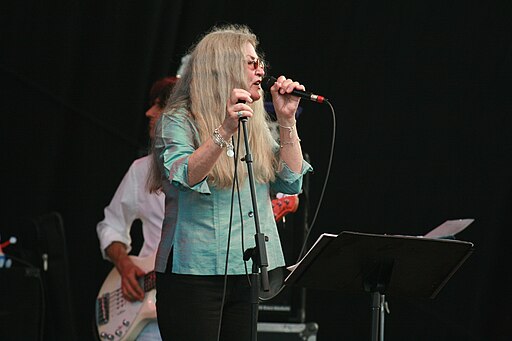
Donna and Keith left the Dead for personal reasons in February, 1979, and Keith died in a car accident a year later. Donna kept on singing. She had her own band, and she was a guest performer at several Dead events, including a 2016 Dead & Company concert at Fenway Park in Boston. Along with other members of the Grateful Dead, she was inducted into the Rock & Roll Hall of Fame in 1994.
Yesterday, during my morning walk, I listened to Back Around, by the Donna Jean Godchaux Band. The album can be found on Apple Music and Spotify and probably other streaming services as well. It’s a good album, and I particularly like the richness of Donna’s voice on the song “Darkness Darkness.” Why did it take me so long to learn her story? I will ask the cards—the tarot cards, that is.
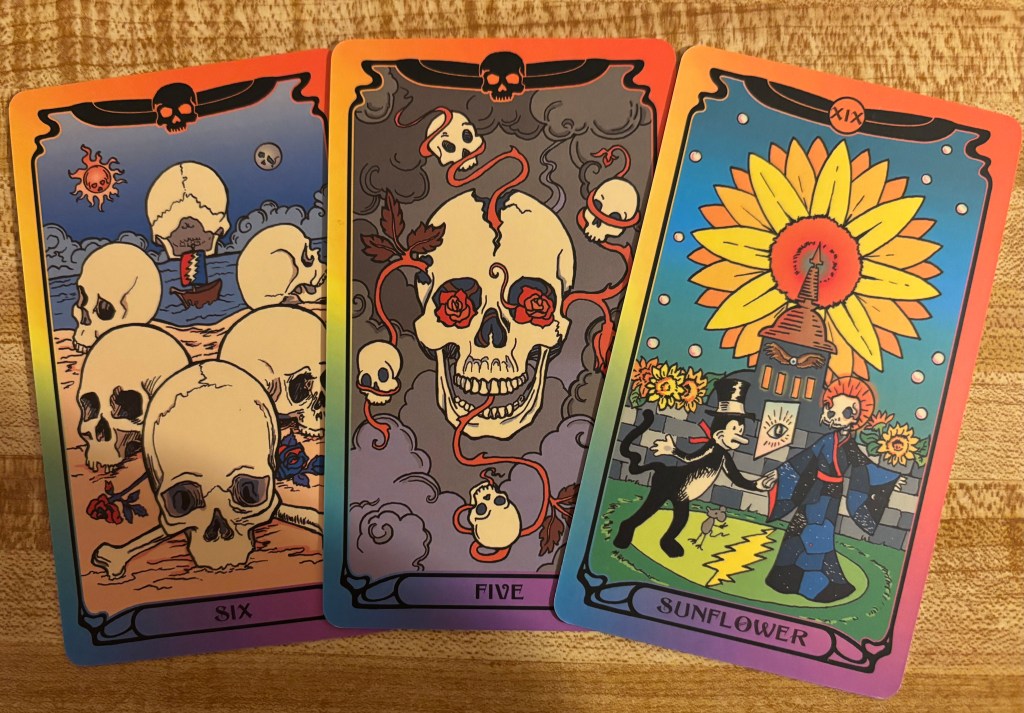
I’m talking about the Grateful Dead Official Tarot Deck, which I purchased a few days ago. It’s wildly different from my other tarot decks, with a Storyteller instead of a Fool and a Musician instead of a Magician. The suits of the Minor Arcana are Roses, Skulls, Bolts, and Bears, and each suit begins with a Terrapin instead of an Ace. The artwork is what any child of the 60s would expect: lots of skeletons, lots of color, and everything beautiful despite the bones. Card XIII is called River and, according to the guidebook, suggests that “sweet surrender can rock your soul and set you free.” I haven’t had the cards long, but I’ve gotten some good readings from them. The long, strange trip continues.

 I Never Meant To Sail So Goddam Far